U.S. Tariff Escalation: What B.C. Businesses Need to Know
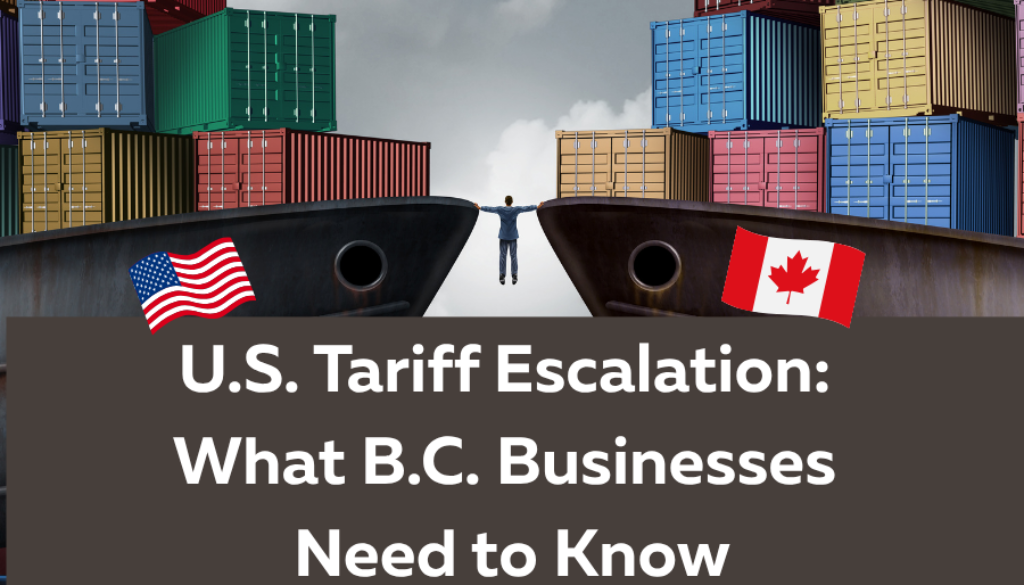
The Canada-U.S. trade dispute has escalated again, creating additional uncertainty for Canadian and B.C. businesses.
On September 8, the U.S. announced changes that expand the list of Canadian products subject to additional 50% tariffs, while also announcing new import bans on certain Canadian products. The expanded tariff measures take effect September 15, with the new import bans scheduled to begin September 29, 2026.
What does this mean for B.C. businesses?
The impacts are not limited to large exporters. The BC Chamber of Commerce identifies several B.C. sectors facing significant exposure, including:
- Forestry and wood products – plywood, engineered wood, doors, frames and fencing.
- Pulp, paper and packaging – including products used throughout food, e-commerce and manufacturing supply chains.
- Agriculture and greenhouses – including nursery products, flowers, seeds, hops and honey.
- Wine, beer and spirits – particularly important to B.C.’s wine and tourism industries.
- Dairy and food products
- Construction and manufacturing materials – including cement, glass, tools, windows, doors and furniture.
- Industrial machinery and equipment
- Plastics and packaging
- Retail and consumer goods
- Marine and transportation equipment
Even businesses that do not export directly to the U.S. may feel the effects through higher input costs, changing supply chains, reduced customer demand or increased transportation and customs costs.
Key dates to know
September 15, 2026: Expanded U.S. 50% tariff lists take effect for affected products.
September 29, 2026: New U.S. import bans take effect on selected Canadian products, including certain alcoholic beverages and dairy products, with additional restrictions related to motor vehicles.
Canada has also implemented 15%, 25% and 50% counter-tariffs on $27.6 billion of U.S. imports, targeting products including steel, dairy, appliances, agricultural equipment, pulp and paper, plastics and electronics.
What should businesses do?
If your business imports from or exports to the U.S., now is a good time to:
- Check the HS/HTS tariff classification of your products.
- Review whether your products, suppliers or customers could be affected.
- Speak with your customs broker or trade advisor before making pricing or shipping decisions.
- Review contracts for tariff, pricing and delivery provisions.
- Assess the impact on inventory, transportation and supply chains.
- Consider opportunities to diversify markets and suppliers, including within Canada.
The BC Chamber also recommends looking beyond the U.S. market and exploring federal and provincial trade programs that can help businesses pursue opportunities in the Indo-Pacific, Europe and other markets.
The Chamber’s role
The Sicamous & District Chamber of Commerce recognizes that trade uncertainty can affect businesses of all sizes. We will continue to monitor developments and advocate through the BC Chamber of Commerce and Canadian Chamber network for stable, predictable and rules-based trade.
If tariffs, supply chain disruptions or other trade measures are affecting your business, we want to hear from you. Member feedback helps inform Chamber advocacy and ensures the challenges facing businesses in our region are being brought forward.
Further information
Government of Canada – U.S. Tariffs & Countermeasures
Canada’s current list of U.S. products subject to Canadian counter-tariffs
Government of Canada – Support for Businesses Affected by U.S. Tariffs
Federal tariff response and business support programs
U.S. Government – September 8 Tariff Changes
U.S. tariff proclamation – expanded Canadian product list
U.S. Government – New Import Restrictions
U.S. import restrictions on certain Canadian products
BC Chamber of Commerce – B.C. Tariff Impact Overview
The BC Chamber’s member explainer provides a sector-by-sector look at how tariffs are affecting B.C. businesses.
Important: Tariff treatment is product-specific and can depend on the applicable HS/HTS code, origin and shipment circumstances. Businesses should confirm their specific situation with a qualified customs broker or trade professional before making decisions.